#AmplifyChoice: The Case For Charter Schools

At the recent Amplify Choice event held in Denver, Colorado, participants heard from advocates and elected officials in the state on the issue of charter schools.

Amplify Choice Kick off SmallIn 1993, Colorado adopted a charter school law. Since it’s inception, Colorado has seen a healthy number of charter schools formed.

Currently, there are 226 charters schools and one-third of the state’s districts have a charter school in them.

That translated to 108,793 students, which is about 12% of the state student population in K-12. Denver (K-12) has 18% of their students  now attending a charter school.

From the mid 2000’s through 2005, Denver started to really embrace charters.

At the time, Denver had the lowest rates of academic growth of Colorado medium and large districts. Out of 98,000 open seats, 31, 000 were empty.

Almost a quarter of Denver students left Denver Public Schools for private schools in other districts or charters at the cost of $125 million a year to the district and less than 29% of students graduated in 4 years.

By Fall 2014, the percentage of students scoring at or above grade level increased from 33 to 48% in reading, writing and math. Flashing forward to today, 65% of students are now graduating on time.

In short, Denver charter schools are outperforming their traditional public school counterparts:
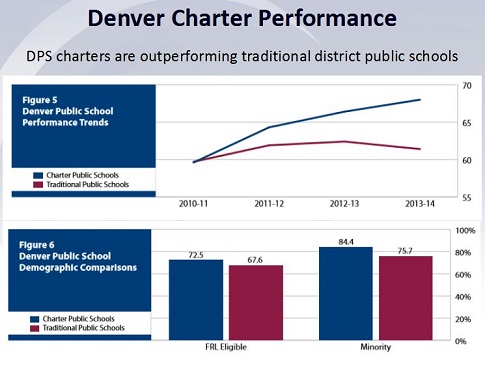
Schaller Charters OutPerform Slide sm

Dan Schaller, Director of Advocacy at the CO league of Charter Schools, gave a presentation on the successes and lessons learned with charter schools in Colorado. Schaller said that, “Denver’s embracing of charters is the key. In the last decade, charters have seen as a key strategy for improving education.”.

Schaller attributed Denver’s success with charters to their increased autonomy coupled with increased accountability.

Schaller stressed the point that charter schools are public schools and are funded as such. Schaller was asked about what the process entailed in stripping a charter if they aren’t working out.

Schaller commented that charters are subject to stringent accountability measures, stating that charters have, “3-5 year contracts” and a, “Stipulation of turn around status of 2 or more years, there has to be a process engaged to possibly end and take action before renewal date comes up.”.

It was also made known that Colorado charters are serving more students of color and ELL students than traditional schools. During the 2015-16 school year, 51,052 students of color attended a charter school. That’s 46.9% of the charter school population. See more Colorado Charter School Quick Facts.

In Colorado, students can enroll across district lines by using their open enrollment system.

Schaller’s presentation also highlighted the funding gap that so many other states also see when it comes to charter schools.

Colorado employs state and federal funding as well as what is called a Mill Levy Override to fund their districts. These overrides are a type of property tax used to help fund schools. In most districts, the Mill Levy Override fees are not being shared equitably with charters.

In a previous interview conducted with Schaller, he noted the disparity in funding — charters overall were receiving only 80 cents on the dollar in comparison with their traditional school counterparts.

“Charter school students represent 12 percent of the K–12 population,” Schaller said. “If charter schools were combined into their own district, they would be the largest district in the State of Colorado at this point. And yet, despite those big numbers, we still see that the typical charter school student is receiving 80 cents on the dollar compared with regular, traditional public school peers.”Heartland School News, 05/05/16

Following Schaller’s presentation was one on the politics and policies of charter schools. Rep. Angela Wilson (D-7) spoke more about the Mill Levy Override situation. Currently, around 61% of districts share the Mill Levy Override money with charters in their district, however the remaining districts do not cost charters an estimated $24 million a year.

Wilson alluded to a very long process of negotiations on the Mill Levy bill (SB 16-188), which ended up being returned to the House Committee for Education and “postponed indefinitely”.

Wilson warned, “Be aware of party politics, partisan politics — be patient, it is a long negotiating process. You won’t always get what you want, so keep going back.”

Wilson also said the one policy item she would like to see passed in the coming session was the Mill Levy Override. “There are 5 districts now that do it right, but there are 43,000 kids out there not getting the funding on an equal basis.” said Rep. Wilson.

Taking a look at North Carolina, there is also a funding gap. In an interview with Dr. Terry Stoops of the John Locke Foundation, the gap is over $1,000.

“According to the latest data available, the average district school in North Carolina receives at least $1,100 per student more than the typical charter school. Unlike district schools, charter schools do not receive state and local capital funding or county-funded debt service payments on their behalf.”

“Despite that funding disparity, charter school students tend to outperform their district school counterparts on state assessments.” said Dr. Stoops.

“North Carolina education officials appear to have little interest in eliminating the funding disparity between district and charter schools.” Stoops explained.  “Many of them seem content to treat charters as a system of separate and unequal public schools.”

“District school leaders want to perpetuate a system of inequitable funding because it impedes the growth of their primary competitor. It is not about the well-being of children. It is about dominating market share.” stated Stoops.

Stoops authored an article in January of this year outlining the gains in School Choice, noting that on the 20th anniversary of charter schools in the state, there were now around 82,000 students enrolled in 158 schools.

In the article, Dr. Stoops also noted that charter schools operate in 59 of the 100 counties in the state and that 16 more schools were on the approval slate for August of 2016.  That number of 16 never materialized and only 8 of that 16 were actually voted on and approved by the North Carolina State Board of Education.

What’s unusual about this turn of events is that all 16 were approved by the Charter School Advisory Board (CSAB), yet the State Board of Education only voted on those schools who received unanimous approval from CSAB.  This represents a break in the usual protocol for charter school approval by the State Board of Education.

CSAB didn’t take the change lying down. The group issued a resolution, requesting the State Board of Education consider each application approved by CSAB. Taylor also sits on the NC Board of Education.

Kari Travis reported on this battle for Carolina Journal.

The article cites Becky Taylor, a non-voting member of CSAB, who seems to have blown off CSAB’s recommendations.

This dismissal by Taylor comes despite thousands of pages being reviewed and interviews taken from applicants across the state. Travis captured Taylor’s comments:

“My concerns were about dialogue that indicated one way of going with the vote, and then when it came to the vote, it was like everybody forgot what they said,” Taylor said of the CSAB’s applications review. “And so I wasn’t sure what that was all about. I do trust the [advisory board] because we do have experts there, and we do rely on the experts, but I just did not hear their discussion matching up with their votes.”

Chairman of the State Board of Education, Bill Cobey, was cited in the article as well.

Cobey said rumors were untrue suggesting that the state board wants the CSAB to recommend only those charter applications that receive unanimous support. Additionally, he said, if the state board rejects a charter’s application one time, it does not prevent that charter operator from seeking and gaining approval in another year, saying every review is treated separately.

Walker disagreed, saying that the state board’s actions may affect how charters are approved in the future.

Meanwhile, those 8 schools approved by CSAB who spent countless hours going through the process and who paid $1,000 each to apply are now back at square one.

Read the full article at Carolina Journal.


Resources: 2016 State of Charter Schools Triennial Report (CO Dept. of Education)
Posted in Charter Schools, EDUCATION, School Choice | Tagged | 2 Comments

Durham School Board Member and Black Lives Matter Activist Resigns

As previously reported by this site, the Durham county school board Durham Sendolo Diaminahwas considering changing their meeting attendance policies in order to accommodate members choosing to engage in activist events over board meetings.

One member in particular,  Sendolo Diaminah, had missed 9 of the last 16 meetings. Diaminah was elected in 2014 and claimed at the time he was running because  he wanted to ‘represent the community’.

Diaminah, who self describes as a “black, queer communist”, was apparently not representing the community as a member of the board, but instead was too busy traveling and being involved in Black Lives Matter protests.

Diaminah came under fire after his attendance record was exposed and has apparently resigned.

Diaminah, however, doesn’t seem concerned about representing the community on education anymore and is now more focused on Donald Trump.

The News and Observer reported:

Community organizer Sendolo Diaminah will resign from Durham Public Schools Board of Education this month to focus on social justice issues and helping to defeat presidential candidate Donald Trump.

“As each of you know, this has not been an easy decision,” he wrote in an email to school board members Saturday. “However, after extensive discussion with the groups and individuals who supported my campaign and presence on the board, I feel clear that this is the right decision.”

[…]

“What I did not know when I ran for office was that during my term the Movement for Black Lives would erupt and that Donald Trump would run for president,” he wrote. “Over the course of the last two years, my paid work as a trainer of Black social justice organizers around the country and my unpaid work building up organizations to defeat Trump have taken on incredible proportions.”

Readers hopefully noticed Diaminah’s admission that he is a, “trainer of Black social justice organizers around the country” and the implication that the school board doesn’t pay so it had to go.

Question: Who is paying him?

In semi-related news, Charlotte Mecklenburg schools will play host to a “Black Lives Matter forum on education inequities”, according to the Charlotte Observer. The event will take place August 25th.

That event is being sponsored by The Charlotte Post Foundation.  The foundation is not registered with the North Carolina Secretary of State as a charity despite their 501(c)3 status, but instead as a corporation.

A portion of their charity status letter reads:

Based on information supplied, and assuming your operations will be as stated in your application for recognition of exemption, we have determined you are exempt from federal income tax under section 501(a) of the Internal Revenue Code as an organization described in section 501(c) (3).

We have further determined that you are not a private foundation within the meaning of section 509(a) of the Code, because you are an organization described in sections 509(a)(2) and 170(b) (1) (A) (vi)

View the Charlotte Post Foundation’s IRS 990 filings.

Posted in A.P. Dillon (LL1885), BlackLivesMatter, EDUCATION | Tagged | 1 Comment

Lt. Governor Forest Takes On NC Per Pupil Spending [Video]

Various professional education protest groups (Aim Higher NC and their parent organization, Progress NC) have been up in arms for years about teacher pay and retention.

Continue reading

Posted in A.P. Dillon (LL1885), EDUCATION, EXCLUSIVE, Lt. Gov Dan Forest, THE LEFT, Video | Tagged , , | Comments Off on Lt. Governor Forest Takes On NC Per Pupil Spending [Video]

WCPSS Board Justifies Cuts Effecting Classrooms While Making Multi-Million Land Purchase

Wake County Public School System (WCPSS) has a budget of over $1.4 billion dollars.  Despite the large budget, WCPSS’s board has been wrestling with a budget gap of around $17.5 million.

Earlier this year, the Wake County Board of Commissioners did not give the district the $35.7 million increase they requested.  The Board of Commissioners had given the district over $44 million the prior year, but this year the Commissioners priority seems to be on their proposed transit plan.

In order to balance the budget, the WCPSS board has compiled a list of budget cuts. The vast majority of these cuts will impact the classroom directly.  It appears the board has chosen the route that would yield the most pain for students and teachers.

Meanwhile, the board approved purchasing a car dealership’s property near downtown Raleigh to the tune of over $6.3 million dollars.  The full amount is actually $6,351,695.

The board plans to convert the car dealership into a high school campus instead of building one from the ground up.  The Wake Board of Commissioners will need to approve the purchase.

Back in May, the WCPSS board approved a $1.98 billion dollar building construction program.

The area where the dealership is located is right on Capital Boulevard and not in particularly good shape as the News and Observer reported:

The City of Raleigh’s 2012 Capital Boulevard Corridor Study described the stretch from the Beltline to downtown as “the most-travelled and least-loved gateway into downtown Raleigh.” Since then, the city has taken steps to improve the corridor’s appearance.

“We just think it fits really neatly into plans for development for that corridor,” Benton said.

Benton said the new school could open as soon as 2019 depending on when the dealership moves and how long it takes to renovate the property.

It is unclear if there has been an estimate done on what renovations to the property would cost or how long they would take.

Details and Documentation of the proposed car dealership purchase:

Benton also told Time Warner Cable news he had no idea what percent of funding is “wrapped up in salaries”:

Facing an over $17 million funding gap, board chairman Tom Benton says they were left with few options, as a large amount of funds go directly to the schools and staff.

“We can’t really go in and start cutting that,” said chairman Tom Benton. “I don’t know what percent is wrapped up in salaries, so the only way to start cutting those is to cut local supplement or to cut people, fire them, and we’re not willing to do that.”

This statement by Benton is interesting since in July Wake County Superintendent Merrill had requested all non-teaching staff receive a 3% pay raise.  This proposal would cost around $2.9 million dollars, according to supporting documents from the WCPSS board work session.

Earlier this year, the WCPSS board amended Superintendent Merrill’s contract by increasing his compensation from $275,000 to $281,302 and extended his end date to 2019.

The board justified Merrill’s increase by stating it is based on his performance on goals set by the board.  This website asked for a copy of these goals, however, WCPSS school attorneys said that despite the goals being tied to taxpayer-funded compensation, the list of Merrill’s goals is not a public record and declined to release them.

The WCPSS board also made Merrill nearly fire-proof by adding a clause that would require a payout of two years of severance pay totaling $560,000.

The WCPSS board also increased the teacher supplemental pay by $44 million.

The bottom line is the majority of these cuts will translate to a direct impact on the classroom, the kids, and the teachers. Teachers more often than not reach into their own pockets for supplies, yet the WCPSS board is cutting student supply fund allotment.

The board also focused on cutting back on classroom and school cleaning.

List of recommended cuts:

  • Freeze Central Office vacancies 90 days – $1 m savings
  • Increase Indirect Cost Revenue estimate – $700 k
  • Reduce Central Services Contract budgets – $2 m
  • Transportation budget reduction to absorb state reduction – $200 k
  • Remove New Business Case for Instructional Technology Facilitators – $843 k
  • Remove New Business Case for MS Performing & Visual Arts MOE – $400 k
  • Remove Program Continuity Business Cases for Title II – $1.1 m
  • Repurpose DSSF funding – $1 m
  • Adjust Academics Allotments based upon actual allotments – $229 k
  • Custodial service reduction of 1 day/week – $3.6 m
  • Heating & Cooling set points adjusted by 1 degree $405 k
  • Decrease Instructional Supply allotment by $3.04 per student* – $481 k
  • Increase Elementary & Middle School ADM formulas by .3 & .15 respectively – $2.7
  •  Increase fund balance appropriated by $3 m

Pages 9-11 of the proposed budget presentation laid out three scenarios involving custodial cleanings being cut paired with other options for additional cuts.

All of the scenarios and options referenced savings from ‘transportation changes’ to the tune of $694,000, however, the transportation changes are not part of the recommended cuts list.

The WCPSS board documentation also did not include the increase in school meal prices.  This is the first meal price hike in 5 years. The K-5 breakfast jumps from $1.00 to $1.25 and lunch from $2.00 to $2.25 Middle and High school breakfasts rise from $1.25 to $1.50 and the lunch will rise from $2.25 to $2.50.


Related Reading:

Posted in A.P. Dillon (LL1885), EDUCATION, Wake County School Board | Tagged , | Comments Off on WCPSS Board Justifies Cuts Effecting Classrooms While Making Multi-Million Land Purchase

Fraternal Order of Police Walk Out on Roy Cooper [Video]

At the North Carolina state convention of the Fraternal Order of Police (FOP), members walked out on Attorney General Roy Cooper.

Members were apparently still upset with Cooper over the mishandling of the Kerrick case and walked out on him as he took questions about it. The FOP had decided to endorse Governor Pat McCrory instead.

WCCB reported:

NCGOP Executive Director Dallas Woodhouse issued the following statement:

“That fact that law enforcement officers walked out on Roy Cooper and endorsed Pat McCrory for governor is a major indictment of Cooper’s 16-year record as the state’s top cop and chief law enforcement officer, which has been weak, ineffective and sparse of real accomplishment. This walkout shows larger unrest for Roy Cooper among the law enforcement community across the state, which has been unhappy with his handling of scandals at the State Bureau of Investigation, failure to fix persistent backlogs at the state crime lab and his refusal to do his job to defend the law even if he personally disagrees with it.”

Posted in A.P. Dillon (LL1885), Campaign 2016, ELECTIONS, Pat McCrory, Video | Tagged | 3 Comments

Controversial NC Student Health Assessment Form Was Quietly Rewritten

Last year parents were outraged to find out that the health assessment form required for entry into Kindergarten in North Carolina schools was being expanded to students of any age or grade level entering the system.

Parents were further outraged when they realized what the form actually asked for. Overly intrusive questions beyond what the law requires were on the form.

Questions included assessing whether or not a child had normal or abnormal genitals is just one example. Other inappropriate topic areas covered included asking if your baby was “full-term” and the form also asked about “trauma”, “family stress” and about your child’s personal/social development.

Calls to legislators ensued and parents took to social media blasting the health form and legislators for apparently not having even read it.

Rep. Torbett filed HB 13 in January 2015 and it was passed by the House in March of the same year. After a series of changes and conference committees, by August 2015, both houses of the legislature had voted to pass the bill.  HB 13 was signed by Governor McCrory on August 18th, 2015.  A full timeline of this bill and the health form as documented by this site are at the bottom of the article.

Upon further inspection of the form, which was created by NC Department of Public Instruction (DPI) and the NC Department of Health and Human Services (DHHS), showed a signature panel which was troubling.  The text read as follows:

“Parental Consent: I agree to allow my child’s health care provider and school personnel to discuss information on this form and allow the Department of Health and Human Services to collect and analyze information from this form to better understand health needs of children in NC.
Signature: _________________ Date:_________”

In essence, by signing this section parents were allowing for DPI and DHHS to contact their child’s doctor about the form without ever notifying them.

Parents should be aware that the old form is still likely on file for any of their children who have enrolled before 2016. It is likely a good idea to request to see your child’s permanent record on file at their school in order to see if they signed this section of the form.

Well, this intrusive health form was quietly changed in January of 2016. The new health assessment form is heavily scaled back and was introduced in a memo sent by DHHS to DPI in this August.

Read the Memo:


See the new Health Assessment Form:

Compare the old health assessment form with the 2016 version.

It is unclear how many districts used the new form for Kindergarten enrollment which began in most areas around February, however in enrolling my own child in Wake County schools, the old form was still in use.  Currently, Wake County schools Kindergarten enrollment packet now has the revised form included.


Articles Related to the Health Assessment Form:

Posted in A.P. Dillon (LL1885), EDUCATION, EXCLUSIVE, NC DPI, NCGA | Tagged , | Comments Off on Controversial NC Student Health Assessment Form Was Quietly Rewritten